10 Ways to Turn Your Florida Scholarship Funds Into Hands-On Learning
By Historical Conquest LLC · September 23, 2026
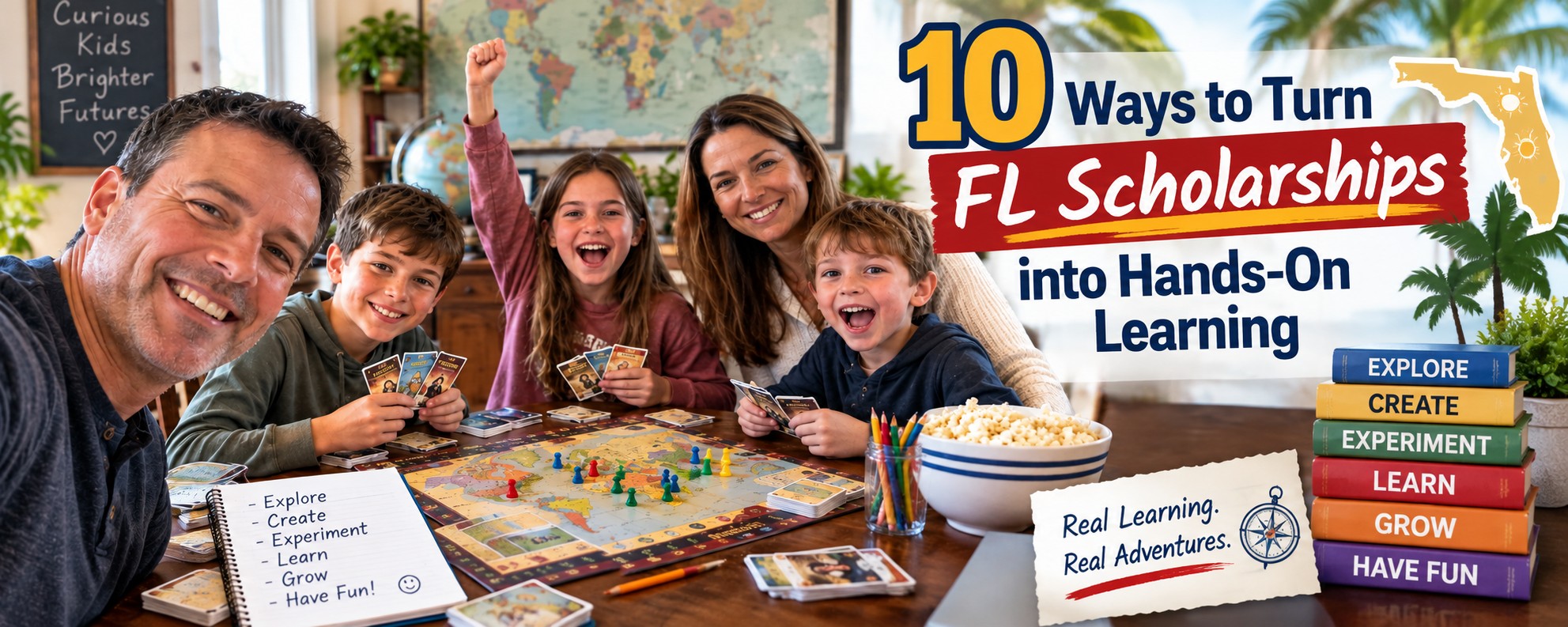
Florida's education scholarship programs give families something extremely valuable: the ability to choose educational resources that fit their children. For families participating in programs such as Florida's Personalized Education Program (PEP), eligible scholarship funds can be used for approved educational expenses that may include curriculum, books, instructional materials, educational software, certain field trips, enrichment opportunities, and other resources. The current Step Up For Students purchasing guidelines emphasize giving families flexibility to customize a student's education.
But having more educational choices doesn't automatically produce a better education. What parents do with those choices matters. Instead of beginning with, "What can I buy with my scholarship?" try asking, "What experiences will help my child understand and remember what they are learning?"
Why Hands-On Learning Matters to Me
When I was in high school, I had trouble remembering much of what I learned in history. Too often, history seemed to consist of reading information, memorizing names and dates, taking a test, and moving to the next chapter. I might remember enough to pass the test, but much of that information didn't stay with me.
What I did remember were the activities that brought history to life. When I had opportunities to participate, make decisions, solve problems, discuss what might have happened differently, or actually use what I was learning, history became much more interesting. Those experiences helped inspire my interest in creating educational resources that engage students instead of simply asking them to memorize information. Florida families now have an opportunity to intentionally build more of those experiences into their children's education.
1. Put History Into Their Hands
Don't only read about history—give children something to do with it. If you're studying Ancient Egypt, construct a model pyramid, map the Nile, examine hieroglyphics, or investigate Egyptian engineering. During a unit on colonial America, cook a historical recipe, examine primary sources, or build a model settlement. Studying medieval history? Design a castle and have your child explain where its defenses should be placed and why.
Action item: For every major history unit, choose at least one activity requiring your child to build, create, investigate, demonstrate, or make a decision.
2. Make Maps Part of Everyday Learning
Geography makes history easier to understand because mountains, rivers, oceans, climate, resources, and transportation routes influenced where people settled, traded, fought, and built civilizations. A wall map, globe, atlas, or other visual resource can therefore become much more than decoration.
Action item: Whenever your child encounters a new civilization, battle, explorer, migration, or historical figure, locate it on a map. Then ask, "What does the geography tell us about why this happened?"
3. Turn Family Game Night Into Learning Time
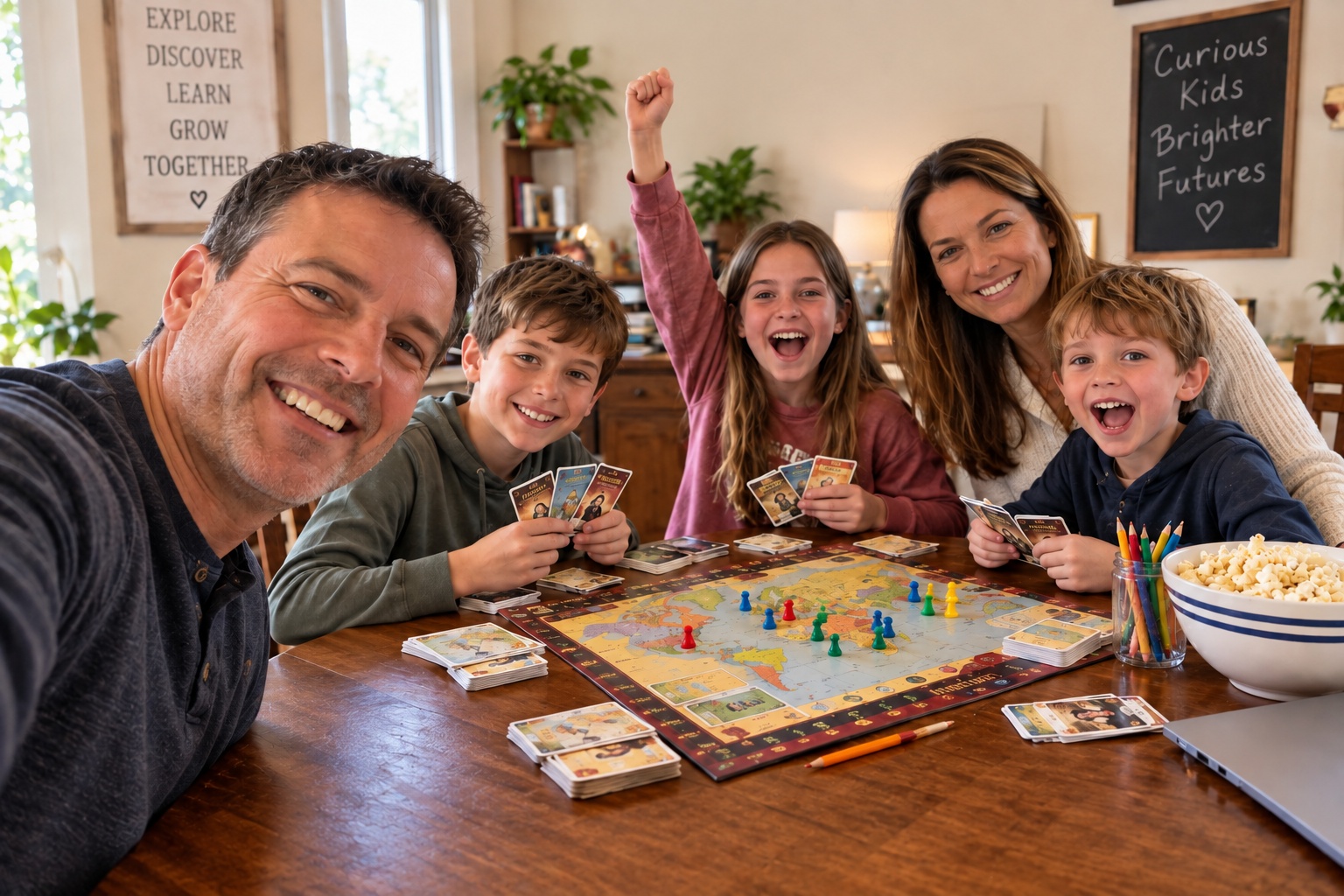
Games can require students to read, calculate, remember information, evaluate risks, develop strategies, communicate, and make decisions. Even better, children may voluntarily repeat the experience. There is a tremendous motivational difference between saying, "Do this worksheet again," and hearing your child ask, "Can we play again?"
Action item: Establish a weekly educational game night. Afterward, ask three quick questions:
- What did you learn?
- What strategy worked?
- What would you do differently next time?
The conversation doesn't need to feel like another test. A few minutes can turn gameplay into an opportunity for reflection and retrieval.
4. Build a Library Around Your Child's Interests
Don't assume history education requires children to march through one enormous textbook. If your child becomes fascinated by Cleopatra, find an age-appropriate biography. If World War II aircraft capture your child's imagination, use that interest to explore aviation, engineering, geography, military history, and the people who designed and flew those aircraft.
Books, including textbooks and workbooks, are among the instructional-material categories addressed by Step Up's current PEP Purchasing Guide. Families should always consult the current rules for their scholarship before purchasing with an expectation of reimbursement.
Action item: Let your child select one educational book this month simply because the subject fascinates them.
5. Take the Classroom Into the Real World
Florida itself is filled with educational opportunities. Studying Spanish Florida? Explore St. Augustine. Studying America's space program? Connect the lesson to the Space Coast. Families can also investigate Indigenous history, forts, museums, archaeological sites, ecosystems, historical homes, and cultural institutions.
Current PEP guidelines recognize qualifying field trips and curriculum-enhancing activities, although eligibility, documentation, limits, and other requirements can vary.
Action item: Turn your next educational trip into a three-part lesson: learn before you go, explore while you're there, and discuss what you discovered afterward.
6. Let Your Child Become the Teacher
One of the simplest hands-on activities costs nothing. After finishing a lesson, close the textbook and say, "Now teach it to me." If your child studied the American Revolution, give them five minutes to explain why it happened. Ask follow-up questions such as "Why?", "What happened next?", and "How do you know?" The student now has to retrieve information, organize it, and communicate it rather than simply recognize the correct answer on a worksheet.
Action item: Once each week, replace an ordinary review assignment with a five-minute Teach the Parent Challenge.
7. Turn Science Into Experiments
Reading about force, electricity, plants, weather, chemistry, or engineering provides important background knowledge, but whenever appropriate, give children opportunities to investigate those concepts. Grow something. Build something. Measure something. Make a prediction and test it. Florida's PEP guidance includes a range of eligible instructional and hands-on materials, but families should verify specific products and requirements before purchasing them with scholarship funds.
Action item: Before an experiment begins, ask your child, "What do you predict will happen, and why?" Record the answer and compare the prediction with the result.
8. Use Technology to Create, Not Just Consume
Screen time doesn't have to mean passively watching videos. Technology can become a research library, laboratory, editing studio, simulation, writing tool, or creative workshop. Students can construct digital timelines, create presentations, research historical mysteries, practice academic skills, or produce their own educational videos. Certain digital materials, software, and subscriptions may qualify under Florida scholarship guidelines when applicable requirements are met.
Action item: Before educational screen time, ask, "What are you going to create, solve, practice, or learn?"
9. Use Electives to Discover Hidden Talents
A student struggling with worksheets might come alive while cooking, gardening, programming, woodworking, painting, performing, or making music. These interests can also connect naturally with academic subjects. Cooking involves mathematics and chemistry. Programming develops logic. Gardening involves biology and environmental science. Woodworking incorporates measurement and geometry.
Action item: Ask your child, "If you could learn how to do one new thing this year, what would it be?" Then investigate ways to connect that interest with the subjects you're already teaching.
10. Build the Education Around the Child
This is the most important principle. Don't begin with, "I have scholarship money. What should I buy?" Begin with your child.
Before your next major educational purchase, answer these three questions:
- My child learns best when __________.
- My child currently struggles with __________.
- My child is fascinated by __________.
Then look for curriculum, books, activities, games, experiences, and other eligible resources that address those answers. That's where educational choice becomes educational personalization.
Before You Spend: Check the Current Rules
Educational doesn't automatically mean reimbursable. Florida scholarship expenses are governed by applicable law, program requirements, purchasing guidelines, and approval procedures, and those requirements can change. Families should check the current Purchasing Guide for their particular scholarship before buying something with the expectation that scholarship funds will cover it. When required—or when eligibility is uncertain—families should follow the applicable pre-authorization process before making the purchase.
For qualifying purchases made out of pocket, families can submit reimbursement requests through EMA with the required documentation. Keep receipts, invoices, proof of payment, product descriptions, and any other documentation required for that expense category.
Step Up For Students PEP Purchasing Guide
The Goal Isn't More Stuff—It's More Learning
When I think back on my own education, I don't wish somebody had handed me another stack of worksheets. I wish I had experienced more opportunities to become involved in what I was learning. Those were the experiences I remembered.
That same philosophy eventually became part of Historical Conquest. The purpose of an educational history game isn't to replace good books, teachers, curriculum, museums, field trips, or serious study. It is to give students another opportunity to use what they're learning. A historical person who was once simply a name in a textbook can become someone a student recognizes, discusses, strategically uses during a game, encounters repeatedly, and eventually wants to learn more about.
Florida families have an extraordinary opportunity to personalize education. Use that opportunity intentionally. Read great stories. Build things. Experiment. Travel. Play games. Ask questions. Debate decisions. Let your children teach you.
Because twenty years from now, the real measure of education won't be how many worksheets your child completed. It will be what they still know—and whether they learned to love learning enough to keep going.