Not in MyScholarShop? How Florida Families Can Buy Educational Products and Request Reimbursement
By Historical Conquest LLC · September 15, 2026 · Scholarships, Curriculum, History
For Florida families using education scholarship funds, MyScholarShop can make purchasing educational materials remarkably convenient. Parents can shop for eligible instructional materials and curriculum through the marketplace connected to their Education Market Assistant (EMA) account, and approved purchases can be paid using available scholarship funds rather than requiring the family to pay first and seek reimbursement later.
But what happens when you find the curriculum, educational game, science kit, book, learning tool, or other resource you want—and it isn't in MyScholarShop?
This is where many parents become confused. They may assume that if something isn't displayed in MyScholarShop, scholarship funds cannot be used for it.
That is not necessarily true.
Step Up For Students' current 2026–27 PEP Family Handbook specifically explains that an item that isn't in MyScholarShop—or even isn't listed in the program Purchasing Guide—may still be an eligible expense. At the same time, being listed in MyScholarShop does not necessarily mean an item qualifies under every scholarship program. Eligibility ultimately depends upon the student's scholarship, Florida law, applicable purchasing rules, and Step Up For Students' policies and approval.
MyScholarShop vs. Buying Outside the Marketplace
Think of MyScholarShop as the convenient first option, rather than necessarily the only place families can obtain educational materials.
Through EMA, families can access MyScholarShop to purchase eligible instructional materials and curriculum. Because the marketplace is integrated with the scholarship system, families generally don't have to pay out of pocket and then wait for reimbursement. Families should still check their available balance and any purchasing restrictions or pre-authorization requirements that apply to the item.
However, families can also purchase eligible educational expenses outside MyScholarShop and submit qualifying purchases for reimbursement. This opens up considerably more possibilities for parents who discover specialized curriculum, educational games, books, supplies, or resources elsewhere.
The key word is eligible.
A product isn't automatically reimbursable simply because it is educational. Likewise, a product isn't automatically ineligible simply because MyScholarShop doesn't carry it.
Before You Buy: Check the Purchasing Guide
Before purchasing something outside MyScholarShop, your first stop should be the current Purchasing Guide for your scholarship program.
Florida requires Scholarship Funding Organizations to establish purchasing guidelines describing authorized uses of scholarship funds. These guidelines can change, so families should check the current version rather than relying on something that was approved in a previous year. Step Up's 2026–27 PEP materials, for example, contain specific rules regarding categories, quantities, frequency limits, supporting documentation, shipping and items requiring pre-authorization.
If the product clearly falls within an eligible category, follow the documentation requirements for that category.
If you're uncertain, don't simply buy it and hope it gets reimbursed.
Step Up specifically advises parents to submit a pre-authorization request when they are unsure whether an item is eligible. Under the current PEP Purchasing Guide, items or services that aren't listed as eligible require approved pre-authorization before purchase. Pre-authorization requests may require an explanation of how the item benefits the individual student's education along with supporting documentation and an approximate cost.
That can save families from paying for something personally and later discovering that reimbursement will not be approved.
Keep Your Receipt—and Make Sure It Has the Right Information
Documentation is extremely important when purchasing outside the marketplace.
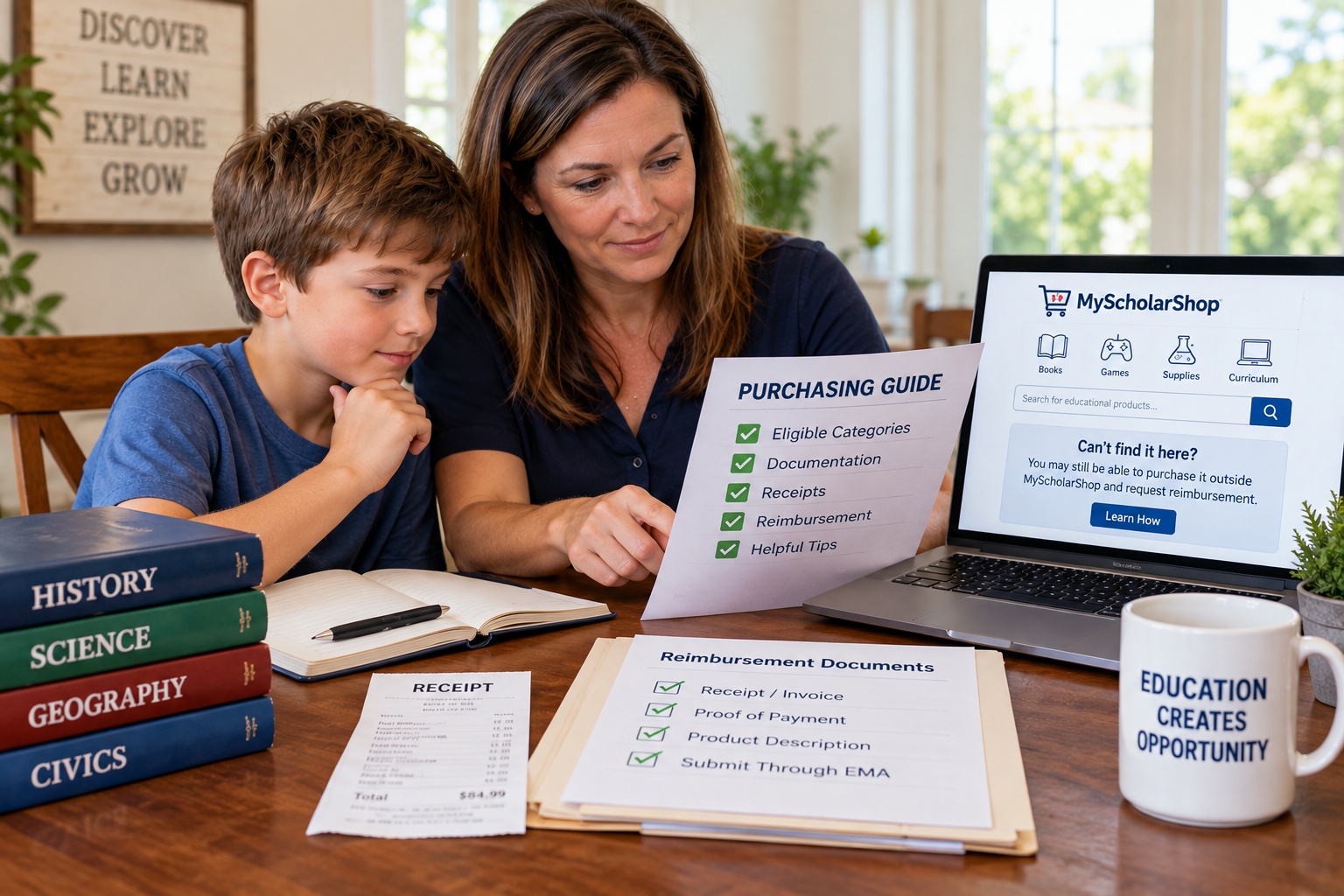
For current PEP reimbursements, Step Up identifies acceptable proof of payment such as a receipt showing the complete transaction date and amount paid, or an invoice showing the transaction date and demonstrating that it was paid in full. Receipts and invoices should provide a clear breakdown of costs, including the base price, taxes, fees and total paid. Some expense categories require additional documentation.
Don't throw away receipts, invoices, order confirmations or other supporting documentation.
For online purchases, also pay attention to shipping requirements. Under the current PEP rules, purchases submitted for reimbursement generally must be shipped to a Florida address or Florida P.O. Box, with an exception for qualifying active-duty military families.
Submitting Your Reimbursement Through EMA
EMA—Education Market Assistant—is the portal families use to manage their scholarship account. Parents can use it to monitor scholarship funds, upload required documents, submit reimbursement requests and access marketplace options.
After making an eligible purchase outside MyScholarShop, families can submit the appropriate reimbursement request through EMA and provide the required proof of payment and supporting documents.
Don't wait until the last minute. For PEP, reimbursement requests are school-year specific. For 2026–27 funds, the current handbook states that eligible purchases generally fall within the July 1, 2026–June 30, 2027 purchase window, with reimbursement requests due by July 31, 2027. There are special rules and exceptions for certain categories, so always check the current handbook for your particular purchase.
Step Up says families should allow up to 60 days for a reimbursement request to be reviewed and processed after all required documentation has been received, although its MyScholarShop FAQ states that its operational goal is seven business days or less. Missing documentation or requests placed on hold can extend the process.
A Simple Rule Before Making a Purchase
When you find an educational product outside MyScholarShop, use this quick checklist:
- Check your scholarship program. Different scholarship programs can have different eligible expenses and rules.
- Check the current Purchasing Guide. Determine whether the product fits an authorized category and whether there are quantity, frequency, price or other restrictions.
- Check whether pre-authorization is required. If you're unsure about eligibility, seek approval before spending your own money.
- Save detailed documentation. Keep the receipt or paid invoice, proof of payment, product information and any additional documents required for that expense category.
- Submit the reimbursement through EMA. Make sure the request matches the purchase and any approved pre-authorization.
Most importantly, remember this distinction: Not in MyScholarShop does not automatically mean not eligible—but "educational" does not automatically mean reimbursable either. Step Up reviews reimbursement requests under Florida law, Department of Education rules, and its applicable policies and procedures.
More Choices Can Mean More Personalized Learning
One of the greatest advantages of Florida's education scholarship programs is the ability for families to personalize a child's education. One student may thrive with traditional textbooks, while another learns better through educational games, manipulatives, experiments, historical simulations, hands-on projects, specialized curriculum, or digital resources.
That's why families shouldn't necessarily stop searching simply because the resource they want isn't displayed in MyScholarShop.
MyLearningSource can help families discover educational products from a broader range of educational companies, including resources such as Historical Conquest. However, families should always verify that a particular purchase qualifies under their student's scholarship and the current purchasing rules before purchasing it with the expectation of reimbursement.
The goal isn't simply to spend scholarship dollars. It is to use the educational choices available to build an education that works for your child.