Notice to Educators = The Science of Fun: Why Students Remember More When They Enjoy Learning
By Xogos Gaming · September 8, 2026 · Curriculum, Games, Math, History
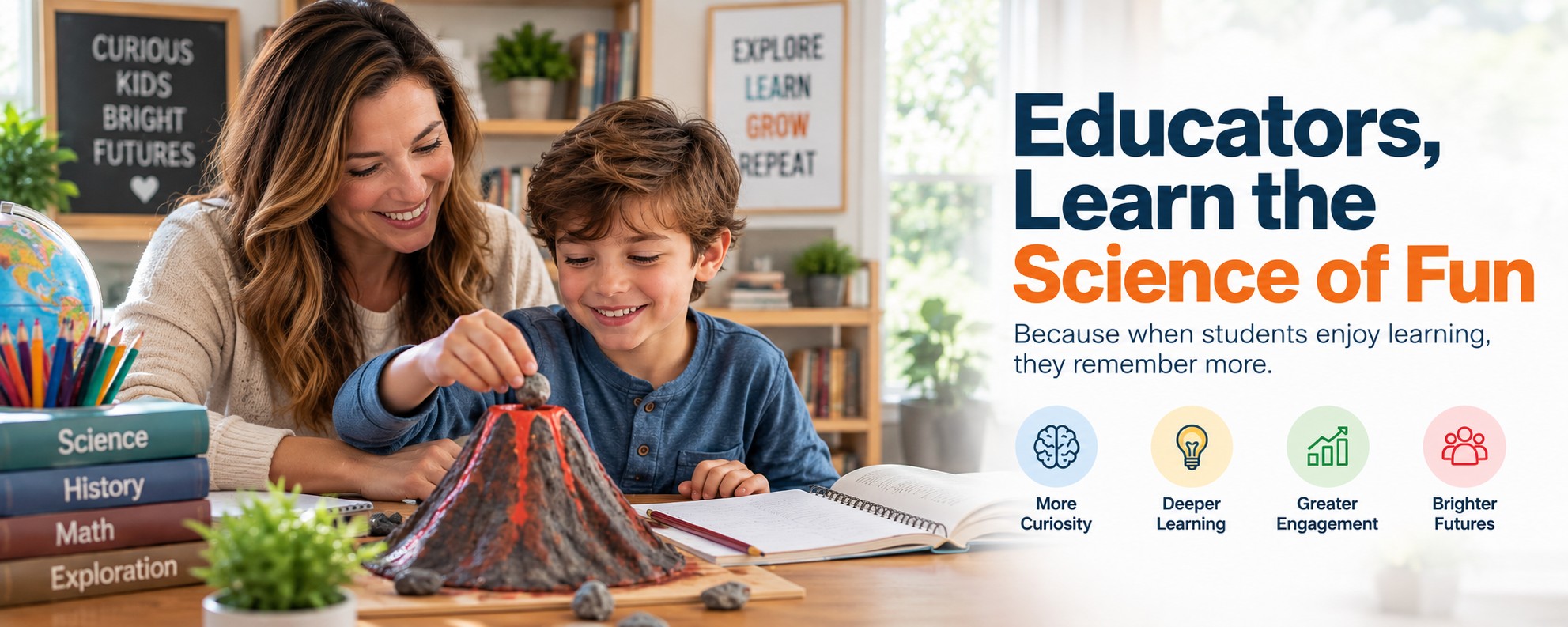
Fun and Learning Are Not Opposites
For generations, education has often treated fun and serious learning as if they were opposites. If students are laughing, competing, experimenting, building, or playing a game, it can look like they are taking a break from school. Yet learning science suggests something much more interesting: when enjoyment creates curiosity, attention, meaningful challenge, feedback, and repeated practice, fun can become a vehicle for rigorous learning rather than an escape from it.
Parents see this phenomenon all the time. A student may struggle to remember ten vocabulary words but somehow memorize dozens of characters, locations, strategies, and rules from a favorite game. Another child may resist reading three textbook pages but spend an hour researching how to build something they desperately want to create. The important question isn't simply, "How can I make school entertaining?" It is, "What happens when my student becomes interested enough to want to keep learning?"
The Brain Has to Pay Attention Before It Can Remember
Memory begins with attention. Students are surrounded by enormous amounts of information, but only some of it receives enough attention to be processed deeply. Curiosity, surprise, questions, goals, and personal relevance can help direct attention toward what matters.
This gives homeschool parents and educators a powerful strategy: start with the mystery or problem instead of immediately giving the information. Rather than beginning geology by saying, "Today we're studying igneous rocks," place several rocks on the table and ask, "Which one do you think came from a volcano, and how could we figure it out?" Instead of introducing percentages with twenty equations, give the student $500 in imaginary money and challenge them to operate a pretend business.
The academic material hasn't become easier. You have simply given the student a reason to want it.
Curiosity can also help memory. When students genuinely want an answer, they are no longer passively receiving information. They are searching for it. That difference can transform a lesson.
Challenge Is Part of the Fun
Making education fun doesn't mean making education easy. In fact, many of the games children enjoy are difficult. Players lose, try again, change strategies, develop skills, and eventually overcome challenges that seemed impossible when they started.
Education can work the same way. Students need challenges that stretch them without completely overwhelming them. A math problem can be fun when it solves a mystery. Engineering can be fun when a bridge keeps collapsing and the student desperately wants to figure out why. History can become exciting when students must decide what they would have done in the position of a historical leader.
Sometimes the greatest educational word is "yet." The student can't solve the problem yet. They don't understand fractions yet. Their bridge can't hold the weight yet. That creates a reason to try again.
Fun doesn't require removing difficulty. Sometimes overcoming the difficulty is what makes the experience fun.

Why Games Can Make Repetition Powerful
Repetition is necessary for mastering many academic skills, but traditional repetition can become boring. A student may complain about solving twenty similar multiplication problems but willingly attempt the same difficult game level twenty times.
Why? Each attempt feels like progress toward a goal.
This is where games, challenges, simulations, and projects can become valuable educational tools. Students can repeatedly practice mathematics while operating a simulated business, retrieve historical knowledge while playing a strategy game, use geography while planning an expedition, or identify minerals while exploring a geological environment.
The student experiences an adventure or challenge while the educator sees something equally important: repeated practice and retrieval.
Games also provide another valuable element—feedback. A useful learning cycle looks something like this:
- Try — The student attempts the problem or challenge.
- See the result — Something works or doesn't.
- Receive feedback — The student discovers why.
- Adjust — They change their strategy.
- Try again — They immediately apply what they learned.
Failure stops being merely a bad grade. Failure becomes information.
Emotion Gives Knowledge Something to Attach To
Students are also more likely to care about information when it has meaning. Stories, suspense, humor, competition, discovery, accomplishment, and personal relevance can help transform disconnected facts into experiences.
History provides a perfect example. A student can memorize that the Battle of Yorktown occurred in 1781, or the student can examine a map and imagine being George Washington trying to trap Cornwallis while French and American forces close in. Now geography, strategy, personalities, dates, and military decisions become connected.
The student still learns the facts, but now the facts belong to a story.
The same principle works across subjects. Instead of merely teaching buoyancy, challenge students to build an aluminum-foil boat capable of carrying as many pennies as possible. Instead of simply teaching budgeting, give them an imaginary salary and a list of real-world expenses. Instead of assigning a report about Mars, challenge them to design a colony capable of keeping 100 people alive.
Fun doesn't eliminate rigor. Done properly, fun can actually increase the amount of rigor students are willing to tackle.
Five Ways to Make Tomorrow's Lesson More Engaging
Parents and educators don't need elaborate technology or expensive materials to use these principles. Before teaching tomorrow's lesson, try asking:
- Can I turn it into a mystery? Give students something they genuinely want to figure out.
- Can I turn it into a challenge? Give them a goal instead of simply an assignment.
- Can they build or create something? Models, stories, experiments, games, businesses, maps, and presentations can make information useful.
- Can they make meaningful choices? Let students choose between several ways of demonstrating mastery.
- Can they teach it back to me? After the activity, ask the student to explain what they learned without immediately checking the textbook.
These strategies can work in nearly every subject. Mathematics can become running a pretend restaurant. Geography can become planning a cross-country trip on a budget. Science can become an experiment. History can become a debate between historical figures. Writing can become creating a podcast script. Personal finance can become a simulation where financial choices have consequences.
Don't Stop When the Game Ends
Having fun does not automatically mean a student learned something. This distinction is extremely important. The activity should lead somewhere educational.
After an experiment, game, field trip, project, or simulation, ask students questions such as:
- What are three things you remember?
- Why did your first strategy work or fail?
- What surprised you?
- What would you do differently next time?
- Can you teach me how this works?
- How could you use what you learned in real life?
Then revisit some of those ideas several days later. Asking students to retrieve information from memory and returning to it after time has passed are powerful ways to strengthen learning.
The fun gets their attention. Practice, retrieval, application, and review help turn that experience into education.
Why We Are Building Xogos This Way
These ideas are part of the philosophy behind Xogos Gaming. Students already enjoy adventures, exploration, games, technology, competition, creation, and achievement. Instead of constantly fighting those interests, we can ask how they might become gateways into K–12 education.
An adventure game can require mathematics to progress. A geology experience can use the exploration students enjoy in sandbox-style games while introducing rocks, minerals, and Earth science. Historical games can turn people and civilizations into characters students want to understand. Personal-finance simulations can allow students to experience financial decisions before real money is at stake. Online electives can introduce students to interests and potential careers they may never have considered.
Xogos isn't intended to replace parents, educators, books, experiments, outdoor experiences, field trips, or traditional curriculum. It is another tool parents and teachers can use to help students make connections between what they enjoy and what they need to learn.
The principle behind it is surprisingly simple:
When students care, they pay attention. When they're curious, they investigate. When they're appropriately challenged, they keep trying. When practice has a purpose, they are more willing to repeat it. And when education connects with something they already love, learning can become something they pursue rather than something adults constantly have to push.
That is why fun and rigorous education don't have to compete.
The fun can become the reason students are willing to do the hard work.
Families and educators can explore Xogos' educational games and learning experiences at Xogos Gaming