One Plant a Week: A Simple Science Rhythm for Your K-5 Homeschool
By Eden's Table · October 23, 2026 · Science, Curriculum, Guides, Tips
You do not need a lab, a microscope or a stack of textbooks to teach real science in the early grades. You need one plant, a few minutes each day and a reason to look closely.
That is the idea behind Eden's Table, the curriculum I write for K-5 families: one plant a week, studied slowly enough that your children actually remember it. Here is the rhythm we use, so you can try it this week with a plant from your own kitchen or yard.
Why one plant at a time works
Young children learn best when a subject has a face and a story, and a single plant gives them both. Over five days, one plant can carry Bible, science, language arts, math, art, history, geography, Latin and health without stacking ten subjects into one morning. You teach one thing well, and the other subjects ride along.
It is also how Scripture frames the work. In Genesis 2:15, Yahweh placed Adam in the garden to tend it and keep it. Teaching a child to notice, name and care for one plant is a small, real act of that same stewardship.
A five-day rhythm you can start this week
Choose a common kitchen herb from the grocery store, such as mint, basil or rosemary. Then:
- Day 1, meet the plant. Look, smell and touch. Have your child sketch it and label the root, stem and leaf. Younger children can point and name; older children can write.
- Day 2, read and wonder. Read Psalm 104:14 together and talk about why Yahweh made plants for both animals and people. Keep a list of your child's questions.
- Day 3, kitchen lab. Make something simple, like a cup of mint tea or rosemary butter. A grown-up handles the stove and knives; children measure, stir and describe the smell and taste.
- Day 4, count, map and remember. Count leaves, measure a stem and find on a map where the plant first grew. Ask how families long ago used it.
- Day 5, tell it back. Ask your child to narrate what they learned in their own words, then add a drawing and one new word to a notebook page. That page becomes the start of a year-long record.
A note on safety
Start with herbs you bought or that an adult has positively identified. Children should never taste wild plants on their own, because some common Arkansas plants have toxic look-alikes. If your child has allergies or a health condition, check with your doctor before tasting anything new. Plant study is about observation and stewardship first.
If you want it done for you
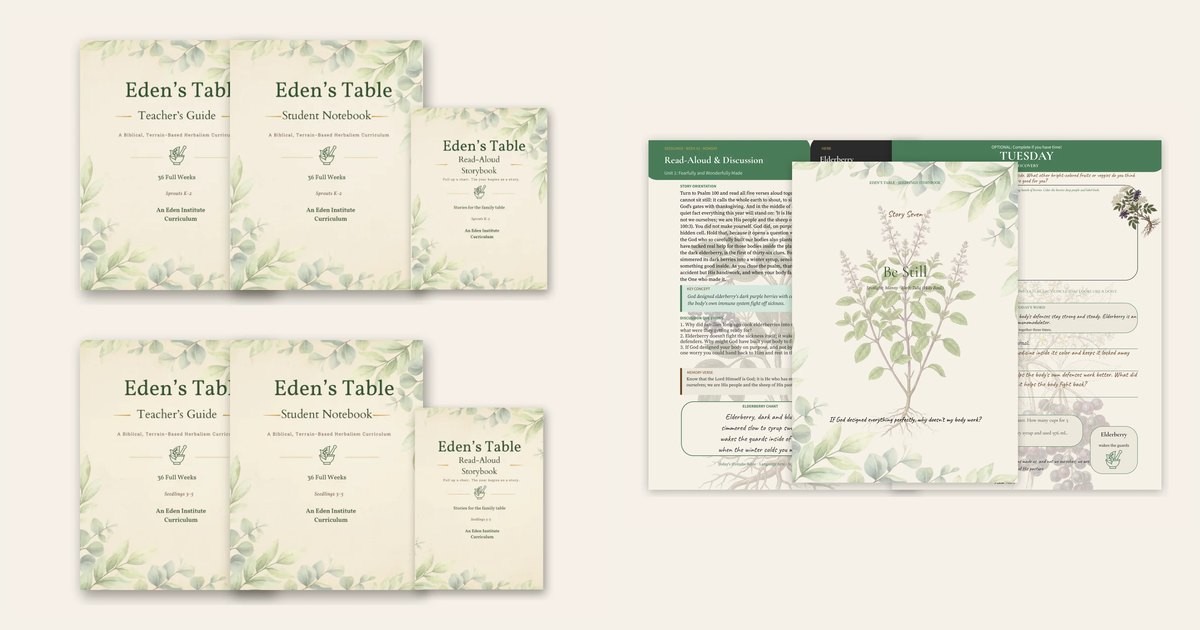
Eden's Table builds this rhythm into 36 weeks of open-and-go lessons at two levels, Sprouts (K-2) and Seedlings (3-5). Each level teaches 36 different plants in three books (Teacher's Guide, Student Notebook and Read-Aloud Storybook), with kitchen labs, memory songs and a family story that runs through the year.
You can try a full week free. Sprouts begins with lavender and Seedlings with elderberry. Get Week 1 free
Using your Arkansas EFA
Eden's Table is an approved Arkansas Education Freedom Account vendor. You can order the printed set by invoice through ClassWallet Direct Pay, and our Arkansas page walks you through each step. See how to order with Arkansas EFA
I would love to hear what your children notice this week.
Camila
Founder, Eden's Table