Why History Matters: Helping Students Learn, Remember, and Love the Past
By Historical Conquest LLC · July 17, 2026
History Is More Than Memorizing Dates
For many students, history has earned an unfair reputation as a subject filled with endless names, dates, and facts that must simply be memorized for a test. Unfortunately, when history is taught this way, students often forget most of what they learned within weeks. Yet history was never meant to be a list of disconnected events. It is the story of real people making difficult decisions, overcoming incredible challenges, inventing new technologies, discovering new lands, fighting for freedom, and changing the course of civilization.
Social studies goes even further by helping students understand geography, economics, government, cultures, and the relationships between people around the world. Together, history and social studies teach students not only what happened, but why it happened, how it affected others, and what lessons we can apply to our own lives today.
When students truly understand history, they become better thinkers, better communicators, and more informed citizens. They begin to recognize patterns, evaluate evidence, appreciate different perspectives, and understand that today's decisions often have roots stretching back hundreds or even thousands of years.
The Goal Isn't Memorization—It's Understanding
The greatest history teachers rarely focus on memorization alone. Instead, they help students ask questions.
- Why did this happen?
- What options did these people have?
- What would I have done?
- What were the consequences?
- What can we learn from this today?
When students begin asking these questions, history becomes a journey rather than an assignment.
Instead of simply remembering that George Washington crossed the Delaware River or that the Roman Empire fell in A.D. 476, students begin understanding the courage, leadership, economics, politics, and human decisions that shaped those events. This deeper understanding naturally leads to better long-term retention because ideas connected through stories are much easier for the brain to remember than isolated facts.
What Research Says About Learning
Educational researchers have spent decades studying how people learn best. One of the most well-known visual models is often called the Learning Pyramid. Although the exact percentages commonly shown with the pyramid are debated and should not be treated as precise scientific measurements, the general educational principle behind it has influenced teaching practices for many years: active participation usually leads to stronger learning than passive participation.
The Learning Pyramid suggests that students generally retain more when they are actively involved in learning than when they simply receive information.
At the top of the pyramid are the most passive methods:
- Listening to lectures - 10%
- Reading independently – 15%
- Watching demonstrations – 30%
Toward the bottom are increasingly active methods:
- Group discussions – 65%
- Hands-on activities – 80%
- Practice by doing or playing applicable games – 80%
- Teaching someone else – 90%
The central idea is straightforward: the more actively students engage with information, the more likely they are to understand it deeply and remember it over time.
Teaching Others: One of the Most Powerful Ways to Learn
Have you ever noticed that when you prepare to teach someone else, you study more carefully?
That is exactly why teaching is such a powerful learning tool. When students explain a historical event to a sibling, parent, classmate, or friend, they must organize their thoughts, identify important details, connect ideas together, and answer questions. This process strengthens memory while exposing any areas they may not fully understand.
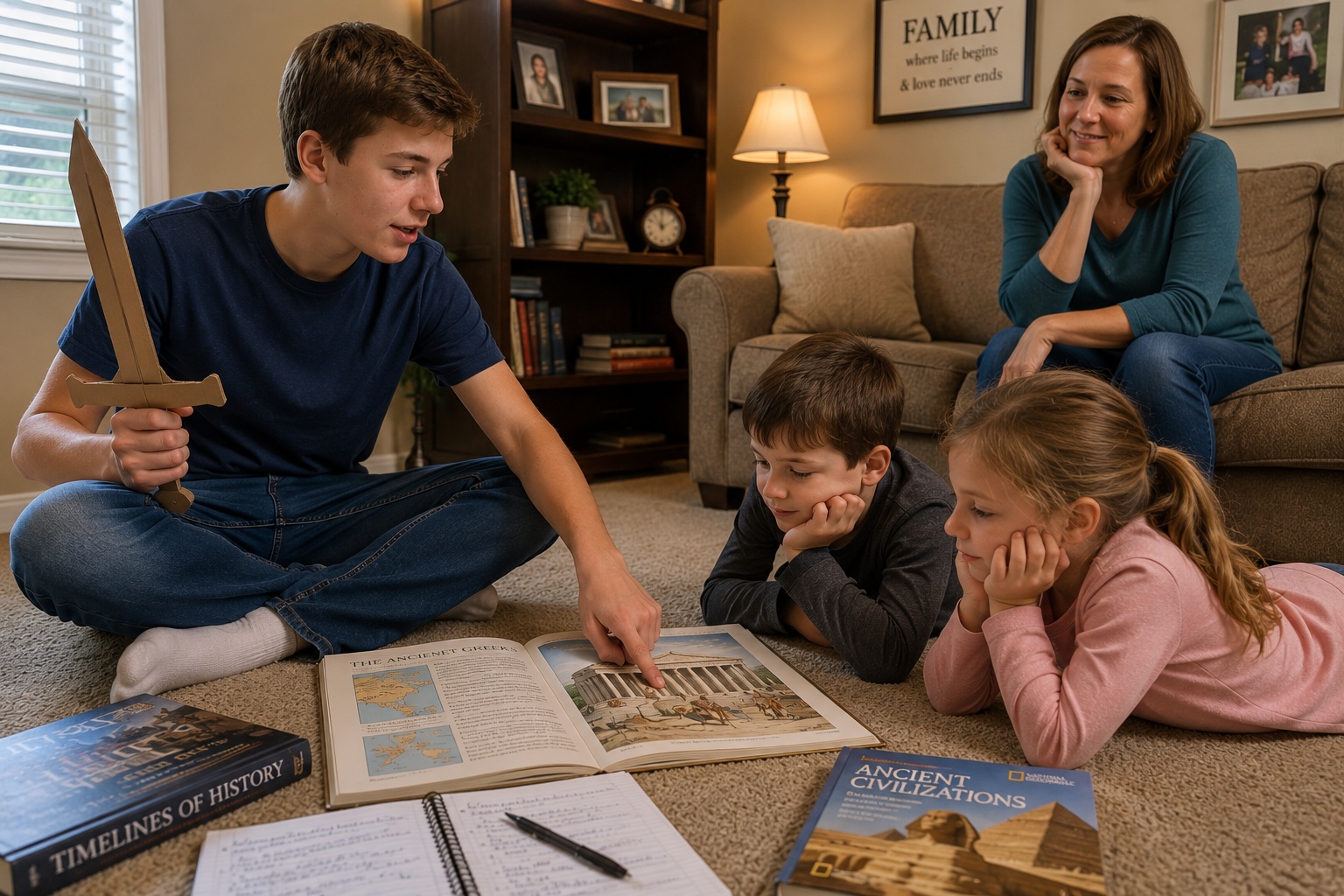
Homeschool families have a wonderful advantage here. Older children can teach younger siblings. Students can create presentations for parents, record short videos explaining historical events, or even act as tour guides through history using maps and timelines.
In public schools, students can teach in small groups, present projects, or explain concepts to classmates. These opportunities help transform students from passive listeners into active learners.
Games and Activities Bring History to Life
The second major lesson educators have learned is that students remember experiences.
Reading about the American Revolution is valuable.
Building a timeline, debating the decisions of the Continental Congress, playing a historical strategy game, creating maps, acting out famous speeches, solving historical mysteries, or participating in simulations often creates memories that last for years.
Games work because they combine several important elements of learning:
- Decision making
- Emotional engagement
- Immediate feedback
- Repetition without boredom
- Friendly competition
- Problem solving
Instead of asking students to simply memorize facts, educational games encourage them to use historical knowledge to accomplish goals. This creates meaningful connections that improve understanding and retention.
Activities do something similar by engaging multiple senses. Students may write, speak, build, draw, move, discuss, or solve problems—all of which reinforce learning in different ways.
Stories Make Learning Stick
The human brain is naturally wired for stories.
Long before books existed, civilizations passed knowledge from generation to generation through storytelling. Stories create emotion, suspense, conflict, heroes, villains, triumphs, and failures—all elements that help our brains remember information.
Rather than introducing a battle by listing its date, location, and outcome, imagine beginning with the story of a frightened young soldier preparing for battle, a family waiting anxiously at home, or a leader facing an impossible decision.
Suddenly, students care. When students emotionally connect with historical figures, history stops feeling distant. It becomes personal.
Reading Still Has an Important Place
It is equally important to recognize that no single teaching method works perfectly for every student.
Some children are exceptional readers. They absorb information quickly from books, quietly reflect on what they have learned, and retain enormous amounts of information through reading alone. These students often thrive with biographies, historical novels, original source documents, and textbooks.
Others may struggle to remember anything from reading but flourish when they participate in discussions, projects, games, experiments, or visual activities.
This is an important reminder that the Learning Pyramid should not be viewed as a rigid rule. It is a helpful guide that encourages active learning, but it should never replace understanding the individual student.
Every child learns differently:
· Some students are visual learners.
· Some are auditory learners.
· Some learn by building.
· Some by writing.
· Some through conversation.
· Others by movement or repetition.
The best educators—whether homeschooling parents or classroom teachers—observe how each child learns most effectively and adjust their teaching accordingly.
Finding the Right Mix for Each Student
Rather than choosing only one teaching style, many successful educators combine several methods together.
A history lesson might begin with reading a chapter, followed by discussing key ideas, watching historical maps or artifacts, playing an educational game, completing a hands-on activity, and finally asking students to teach what they learned to someone else. Each activity strengthens learning in a different way.
Students not only remember more—they enjoy learning more. This balanced approach also helps students develop stronger reading, speaking, listening, critical thinking, and problem-solving skills at the same time.
History Builds Character
History is ultimately the study of human choices. Students encounter examples of courage, sacrifice, leadership, perseverance, innovation, justice, compassion, greed, pride, failure, and redemption.
As they study these stories, they begin asking questions about their own lives.
· What kind of leader do I want to become?
· How should I respond during difficult times?
· What mistakes can I avoid by learning from others?
· How can I make a positive difference in my own community?
These are some of the greatest gifts history can offer.
Helping Every Student Discover a Love for Learning
Whether you are homeschooling one child around the kitchen table or teaching thirty students in a classroom, your greatest goal is not simply helping students pass the next test. It is helping them become lifelong learners.
History and social studies offer incredible opportunities to inspire curiosity, strengthen critical thinking, and build wisdom that lasts a lifetime.
Use books. Tell stories. Ask thoughtful questions. Play educational games. Complete hands-on projects. Encourage discussions. Invite students to teach others what they have learned. Most importantly, pay attention to how each child learns best.
There is no perfect formula that fits every student. Every learner is unique, and every classroom is different.
When we combine proven teaching strategies with an understanding of each student's individual strengths, we create learning experiences that students not only remember—but genuinely enjoy. Those are the lessons that remain with them long after the textbooks are closed and the school year has ended.